


Long before wearables became commonplace—or dashboards started promising optimization—I started tracking data for a simpler reason: curiosity. Sometime around 2018, and more formally by 2019, I began paying attention to my steps, sleep, workouts, travel, and training patterns. At the time, the primary concern was sleep. I was really trying to develop better sleep habits to maximize my performance.
In those early years, tracking felt a bit like problem-solving. I was trying to dial something in—especially sleep—using averages, correlations, and monthly comparisons. I wanted to know how travel affected training, how training affected sleep, and where things quietly broke down. The data from that period consistently pointed to the same conclusion: I wasn’t sleeping enough, I wasn’t winding down well on the road, and I was letting work schedules crowd out the things that helped me feel grounded. Gym time, even then, functioned less as fitness and more as therapy. The numbers didn’t judge that—they simply revealed it.
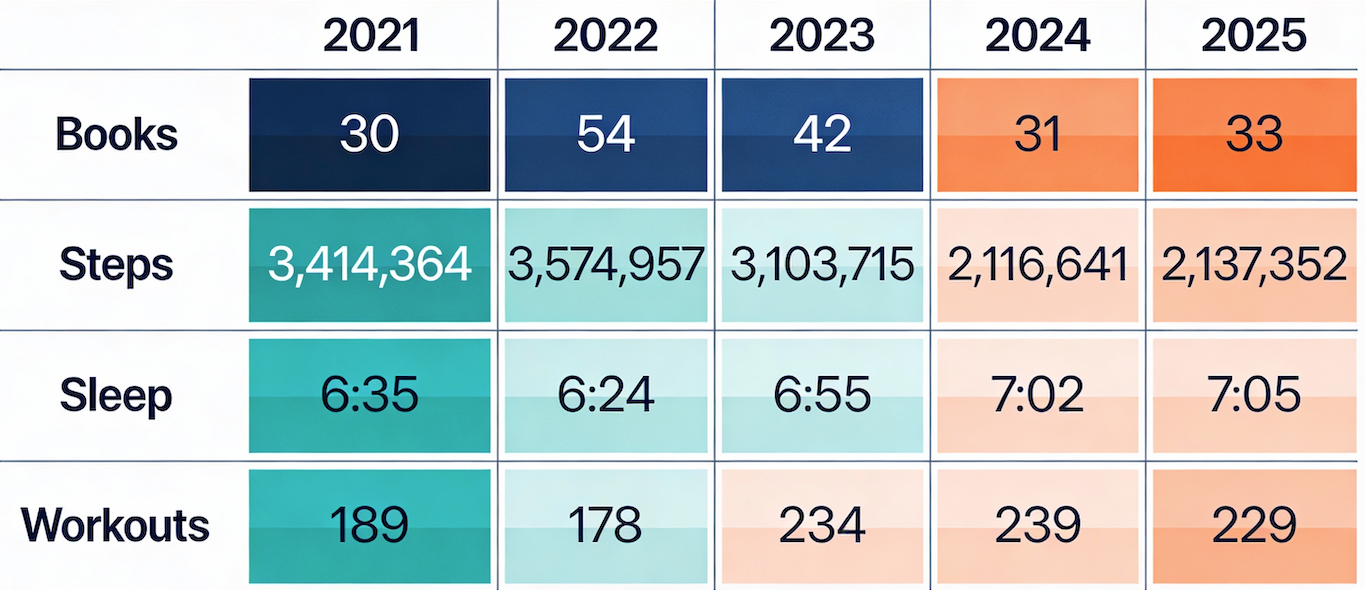
What’s changed since then isn’t the tracking itself, but my relationship to it. By the time I look at the last four years of data (2022–2025), it’s clear that the experiment shifted from fixing to understanding. In 2022, the system still runs hot: high movement, high reading volume, and relatively poor sleep. Likely an anomaly thanks to three months in a cervical collar after the break in my C-5 and C-6 and then a desperate goal to regain my overall strength, endurance.
From there, the numbers slowly soften. Sleep improves year over year. Workout consistency increases, then stabilizes. Steps come down—not because of disengagement, but because movement becomes less frantic and more ambient. Reading volume normalizes and becomes more selective. By 2024 and 2025, the metrics no longer feel like levers I’m trying to pull. They feel like signals. The averages tighten. The variance shrinks. Nothing spikes dramatically, but nothing erodes either.
What stands out most to me now is that I no longer appear to be chasing an ideal version of myself hidden somewhere in the data. Instead, the data seems to be revealing a truer sense of normal. Sleep settles just over seven hours—not perfect, but honest. Training shows up regularly, even if not maximally. Movement remains part of daily life without requiring heroic effort. Reading continues, not as a goal to hit, but as a habit that fits.
In retrospect, the value of tracking since 2018 hasn’t been optimization. It’s been objectivity. The numbers stripped away some of the stories I told myself—about how hard I was pushing, how well I was recovering, or what “should” be possible. What’s left is a clearer picture of how I actually live, and how small, patient adjustments compound over time.
Over the past few years, this data has guided me toward staying fit, curious, and at peace. It also revealed something foundational: small, consistent steps compounded over time create meaningful progress. That realization ultimately led me to start Always Future Group — insight translated into action. I track these metrics not to perfect life, but to support a productive, interesting, and sustainable one. As 2026 unfolds, the experiment continues, trusting that what’s revealed next will point toward new opportunities.